Lake Placid, New York; January 15, 2026. The potential for warmer spring temperatures during maple season causes concern for how to keep sap cool. With a grant from the Northern New York Agricultural Development Program, Uihlein Maple Research Forest Director Adam Wild successfully built do-it-yourself (DIY) sap cooling systems. Wild has published the results of the proof-of-concept project in a “Chilling Maple Sap” information bulletin and a “How to Build a Maple Sap Chiller” guide.
“This project has value for maple producers statewide. The flavor and quality of maple syrup is directly related to sap quality. The ability to chill and hold maple sap prevents spoilage and adds flexibility for producers to boil sap at their convenience, particularly for those producers who also operate dairy farms or have off-farm jobs,” Wild said.
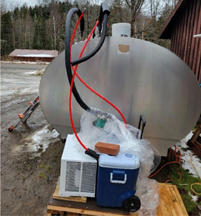
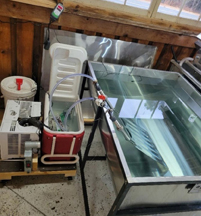
To build the chillers (see photos below), Wild adapted window-size air conditioning units and connected plastic picnic coolers holding a food-grade glycol solution. The units were tested in combination with a submersible wine chilling plate in a stainless steel tank, a 20-plate heat exchanger used with a reverse osmosis pump and a 1,500-gallon, insulated dairy tank with its own cooling plates and supply and return lines. The Upper Hudson Maple Producers Association provided the dairy tank for the testing.
“The use of glycol chilling can be a less expensive alternative to refrigeration for keeping sap cool. The chillers built for this project were extremely effective, providing efficiency in processing the sap at Uihlein with 40 percent less boiling and saving more than 24 hours of labor for post-boil cleanup,” Wild said.
Wild estimates the cost to build the individual chiller units at $300 to $1400.
The “Chilling Maple Sap” information bulletin by Wild includes information on the cooling efficiency of food-grade glycol, freezing points, and how to size a DIY or a purchased chilling system to fit different maple operations.
The “How to Build a Maple Sap Chiller” DIY step-by-step guide includes safety tips, a parts list, cost estimates, photos, and optional add-ons. An added convenience option noted in the how-to guide is the use of Wi-Fi access for remotely monitoring and controlling the sap chilling system.
Wild, who is co-director of the Cornell Maple Program, is continuing use of the DIY units at the Uihlein Maple Forest in the 2026 maple season. The information bulletin and DIY guide are posted on nnyagdev.org (https://nnyagdev.org/index.php/mapleforest/maple/) and available from the Cornell Maple Program (https://blogs.cornell.edu/cornellmaple/).
 Funding for the Northern New York Agricultural Development Program is supported by the New York State Legislature through the New York State Assembly and administrated by the New York State Department of Agriculture and Markets. Learn more at nnyagdev.org.
Photos: As an NNYADP proof-of-concept project, Uihlein Maple Research Forest Director Adam Wild built DIY food-grade glycol chilling systems for use with maple sap holding tanks large and small. Photos: Adam Wild